
Therapy, Counseling, and Psychiatry: Understanding the Differences

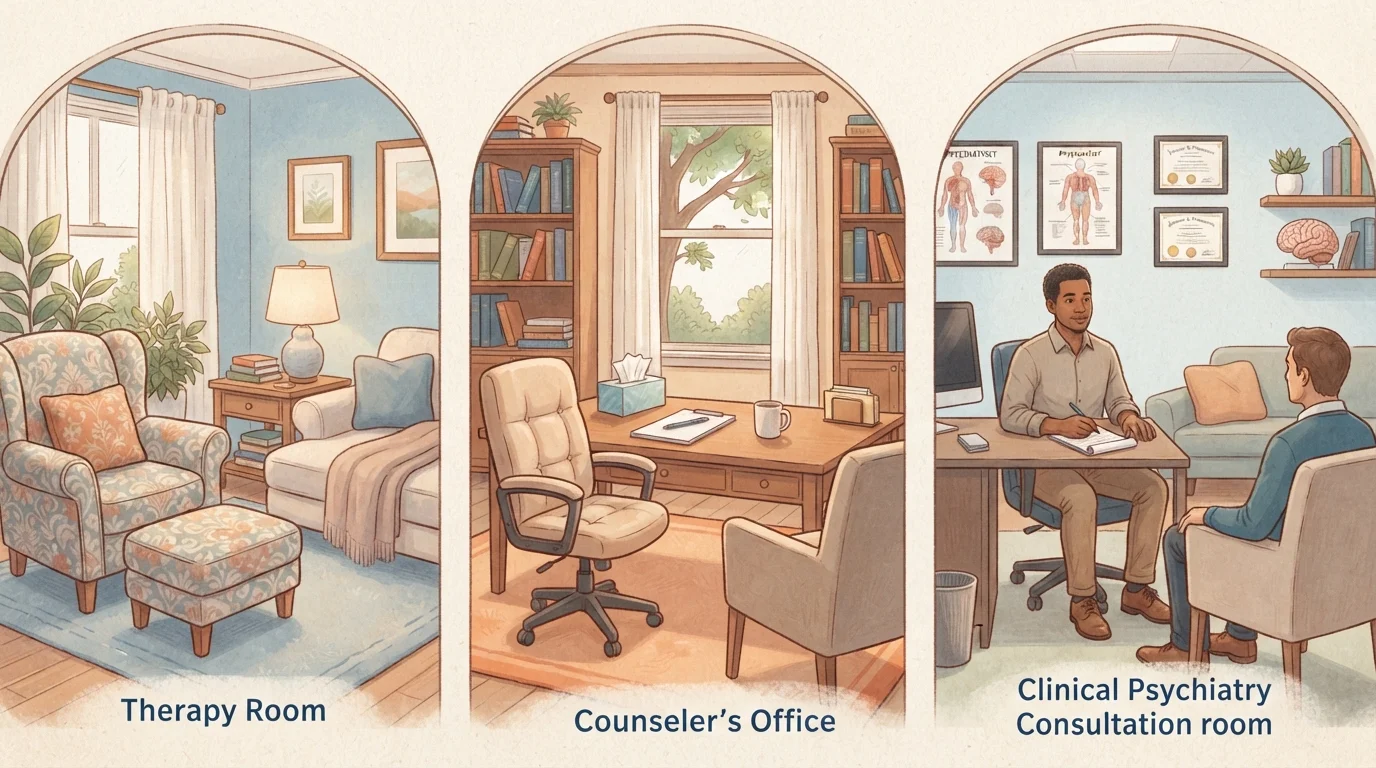
Photo: NemoFinds.com | Search, Explore, Read. editorial
Key Takeaways
- Therapists, counselors, and psychiatrists all support mental health but through different methods and scopes of practice.
- Psychiatrists are medical doctors who can diagnose conditions and prescribe medication; therapists and counselors typically cannot.
- Counselors often focus on specific, time-limited concerns, while therapists may work with deeper or longer-term patterns.
- Many people benefit from seeing more than one type of provider — for example, a psychiatrist for medication and a therapist for talk therapy.
- Insurance coverage varies significantly by provider type; always verify your plan before booking.
Why the Distinctions Actually Matter
When people decide to seek mental health support, one of the first stumbling blocks is simply figuring out who to call. Therapist, counselor, psychiatrist — the terms get used interchangeably in conversation, but they represent meaningfully different training backgrounds, scopes of practice, and approaches to care.
Choosing the right type of provider from the start can save time, reduce cost, and get you to the right kind of help sooner. If you're new to navigating mental wellness, this grounded introduction to mental health basics is a useful place to begin. And if you've run into stigma or confusion around mental health language, this plain-language glossary can help clarify key terms.
The overview below explains what each type of provider actually does — and who each one is typically best suited to help.
Therapists, Counselors, and Psychiatrists at a Glance
These three roles overlap in meaningful ways — all three are trained to support mental and emotional wellbeing — but they differ substantially in education, licensure, and what they're authorized to do.
| Therapist | Counselor | Psychiatrist | |
|---|---|---|---|
| Typical degree | Doctoral or master's (PhD, PsyD, LCSW, LPC) | Master's degree (MA, MS, MEd) | Medical degree (MD or DO) |
| Can prescribe medication | No (with rare state exceptions) | No | Yes |
| Can formally diagnose | Yes, in most states | Varies by license and state | Yes |
| Primary treatment method | Structured talk therapy | Solution-focused counseling | Medication management; some talk therapy |
| Typical session length | 45–60 minutes | 45–60 minutes | 15–30 minutes (med management) |
| Best suited for | Ongoing emotional patterns, trauma, mood concerns | Specific, time-limited challenges | Conditions that may require medication |
It's worth noting that the word "therapist" is sometimes used loosely to refer to any of these providers. In clinical and legal terms, however, a therapist is typically a licensed mental health professional — such as a psychologist, licensed professional counselor (LPC), or licensed clinical social worker (LCSW) — who provides structured talk-based treatment.
What Each Provider Actually Does in Practice
Psychiatrists
Psychiatrists complete medical school and then specialize in mental health. Because they are physicians, they can order lab tests, make formal diagnoses, and prescribe medication. Many psychiatrists today focus primarily on medication management — evaluating symptoms, prescribing and adjusting medications, and monitoring side effects — rather than providing ongoing talk therapy. Appointments tend to be shorter and more clinical in nature.
Consider a Team-Based Approach
Therapists
Licensed therapists (including psychologists, LCSWs, and LPCs) are trained in structured psychological treatments. These include approaches like cognitive behavioral therapy (CBT), which focuses on thought and behavior patterns; EMDR, used often for trauma; and psychodynamic therapy, which examines how past experiences shape current behavior. Sessions are typically 45–60 minutes and may occur weekly over months or years depending on goals.
Counselors
Counselors often work within a more defined scope — addressing specific concerns such as grief, relationship difficulties, substance use, or career transitions. Many counselors hold a master's degree and a state license. The work tends to be more solution-focused and shorter-term than traditional psychotherapy, though there is significant overlap depending on the individual practitioner.
If you're trying to read your own signals about whether professional support is warranted, this article on recognizing when stress crosses a threshold can help clarify when to act.
Navigating Insurance and Access
Coverage for mental health services varies widely. Under federal law, insurers offering mental health benefits are generally required to cover them at parity with medical benefits — but what's actually covered, how many sessions are included, and whether your specific provider is in-network depends entirely on your plan. For a foundational overview of how health plans work, see this explainer on health insurance basics.
1 in 5
U.S. adults with a mental illness annually
According to the National Institute of Mental Health, approximately one in five U.S. adults lives with a mental illness in any given year.
~55%
Adults with mental illness who receive no treatment
SAMHSA's National Survey on Drug Use and Health estimates that roughly half of adults with a mental illness do not receive treatment in a given year.
Practical steps worth taking before your first appointment: verify whether the provider accepts your insurance, ask about their cancellation policy, and confirm whether telehealth options are available. Many providers offer sliding-scale fees for uninsured or underinsured patients.
If you're preparing to talk to someone you trust about seeking help in the first place, this guide to opening that conversation offers practical framing.
This article is for general informational purposes only and does not constitute medical advice. Always consult a qualified healthcare professional for guidance specific to your situation.
The content on this site is for informational purposes only and is not a substitute for professional advice. Always consult a qualified professional for guidance specific to your situation.