
Hands-Free vs. Phone-Free: The Distraction That Doesn't Go Away

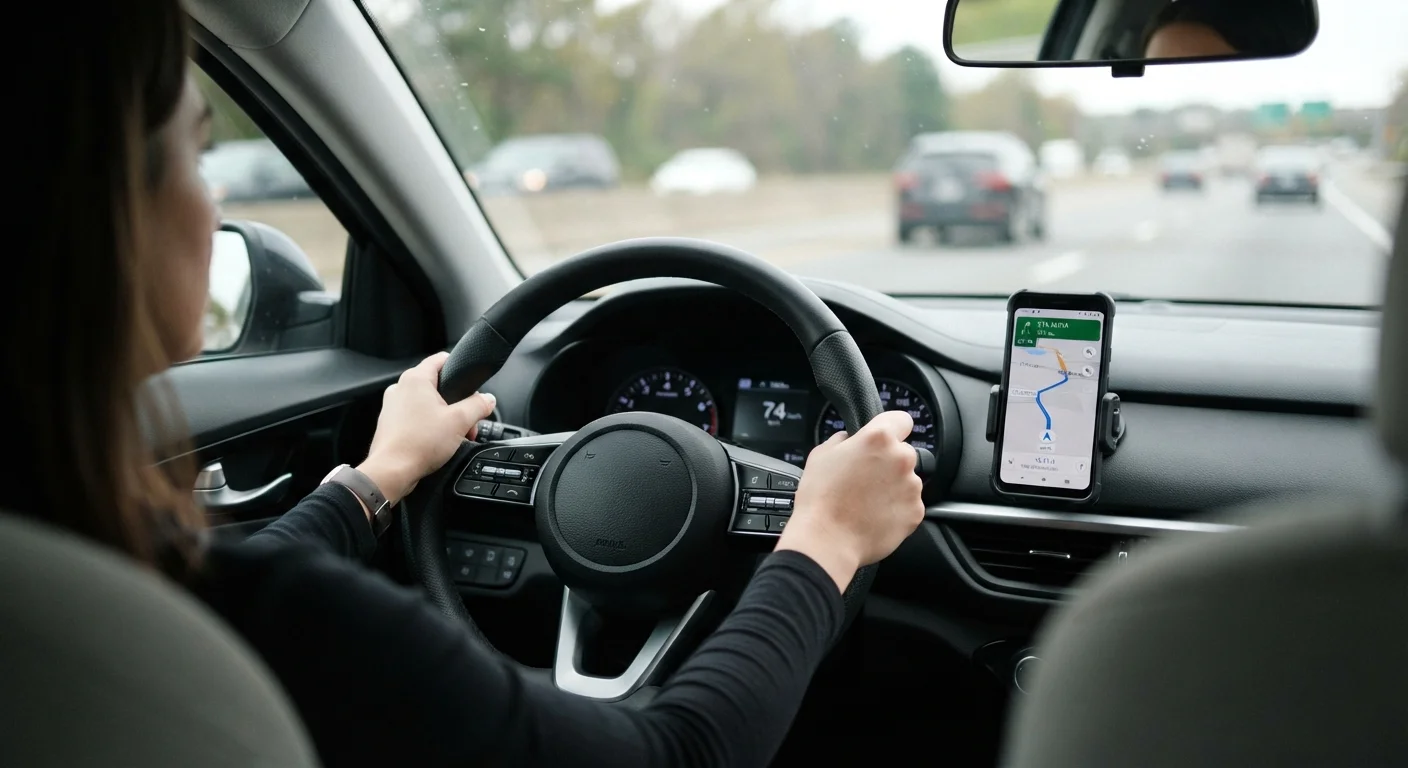
Photo: NemoFinds.com | Search, Explore, Read. editorial
Key Takeaways
- Hands-free calling keeps both hands on the wheel but does not eliminate mental distraction.
- Research consistently shows that phone conversations — even via Bluetooth — impair reaction time and situational awareness.
- Phone-free driving removes all mobile communication distraction, offering the highest measurable safety margin.
- Many U.S. states now require hands-free use as a legal minimum, but legal does not mean risk-free.
- Short, urgent calls using voice commands carry less risk than extended, emotionally demanding conversations.
Why the Distinction Matters
Most drivers understand that holding a phone while driving is dangerous — and illegal across much of the United States. What's less commonly appreciated is that switching to a hands-free device doesn't make the conversation itself disappear. The phone moves from your hand to your ear or your car's speakers, but your brain is still juggling two demanding tasks at once.
This matters because distracted driving is far broader than most people assume. As our overview of what distracted driving actually covers explains, cognitive distraction — where mental focus drifts away from the road — is just as real as visual or manual distraction, and often harder to recognise in yourself.
The hands-free vs. phone-free debate is ultimately about how much distraction a driver is willing to accept, and whether "legal" and "safe" mean the same thing.
How Each Approach Affects Driver Attention
Manual distraction (taking your hands off the wheel), visual distraction (looking away from the road), and cognitive distraction (thinking about something other than driving) are the three recognised categories. Hands-free calling eliminates the first two but leaves the third largely intact.
| Criterion | Hands-Free Calling | Phone-Free Driving |
|---|---|---|
| Manual distraction | Eliminated | Eliminated |
| Visual distraction | Mostly eliminated | Eliminated |
| Cognitive distraction | Remains — often significant | Eliminated |
| Reaction time impact | Measurably slowed | Unaffected |
| Legal compliance (most U.S. states) | Yes | Yes |
| Situational awareness | Reduced | Fully maintained |
| Practical convenience | High | Requires behaviour change |
Studies conducted by the National Safety Council and academic researchers have consistently found that drivers using hands-free phones can miss seeing up to 50% of the visual information in front of them — a phenomenon sometimes called "inattention blindness." The brain, trying to process conversation, suppresses processing of peripheral visual data.
Reaction times during phone conversations — hands-free included — have been measured as significantly slower than baseline driving, with some studies showing impairment comparable to driving at the legal blood-alcohol limit. Phone-free driving, by contrast, keeps full attentional resources directed at the road.
~50%
Visual information missed during phone calls
The National Safety Council cites research showing hands-free phone users can fail to process roughly half of driving-relevant visual cues due to inattention blindness.
4x
Increased crash risk when using a phone while driving
Research published by the National Safety Council consistently estimates that phone use while driving — including hands-free — quadruples crash risk compared to undistracted driving.
27 seconds
Cognitive distraction duration after a voice command
AAA Foundation for Traffic Safety research found that driver attention remains significantly impaired for up to 27 seconds after completing a voice-activated task.
The Legal Landscape: Minimum Standard, Not Safety Standard
Nearly all U.S. states now prohibit handheld phone use while driving. Many require drivers to use hands-free devices as a substitute. This legal shift was an important step, but it's worth understanding what the law actually measures: it addresses manual and, in part, visual distraction. It does not — and realistically cannot — regulate cognitive distraction.
That gap means a driver following the law to the letter may still be meaningfully impaired. This mirrors a broader pattern in road safety: legal minimums set a floor, not a ceiling. Just as familiarity with a route can breed complacency, as explored in our piece on safe driving habits experienced drivers often drop, legal compliance can create a false sense of security.
State Laws Vary — Check Your Local Rules
Drivers should treat hands-free calling as a harm-reduction tool rather than a safe alternative — using it only when necessary, keeping conversations short, and pulling over for anything complex or emotionally charged.
Practical Strategies for Reducing Phone-Related Risk
Whether you're committed to phone-free trips or need to use hands-free occasionally, a few habits significantly reduce risk:
- Enable 'Do Not Disturb While Driving' — Both iOS and Android offer automatic modes that silence notifications and send auto-replies when the vehicle is moving.
- Set expectations before you leave — Let frequent callers know you don't take calls while driving. Most people will adapt quickly.
- Use voice commands sparingly — Short voice-activated tasks (setting navigation, skipping a song) carry less cognitive load than sustained conversation.
- Pull over for complex calls — If a conversation is emotionally difficult, work-critical, or requires real-time problem-solving, stop the vehicle first.
- Recognise fatigue as a compounding factor — Cognitive resources are limited. A tired driver handling a phone call has even less capacity for the road. Our guide on driver fatigue and its hidden risks covers how impairment compounds when multiple stressors combine.
The safest trip is one where your full attention stays on the road from start to finish. Hands-free technology is a meaningful step up from handheld use — but phone-free remains the standard that best protects you, your passengers, and everyone sharing the road.
The content on this site is for informational purposes only and is not a substitute for professional advice. Always consult a qualified professional for guidance specific to your situation.