
Tankless vs. Tank Water Heaters: Understanding the Long-Term Picture

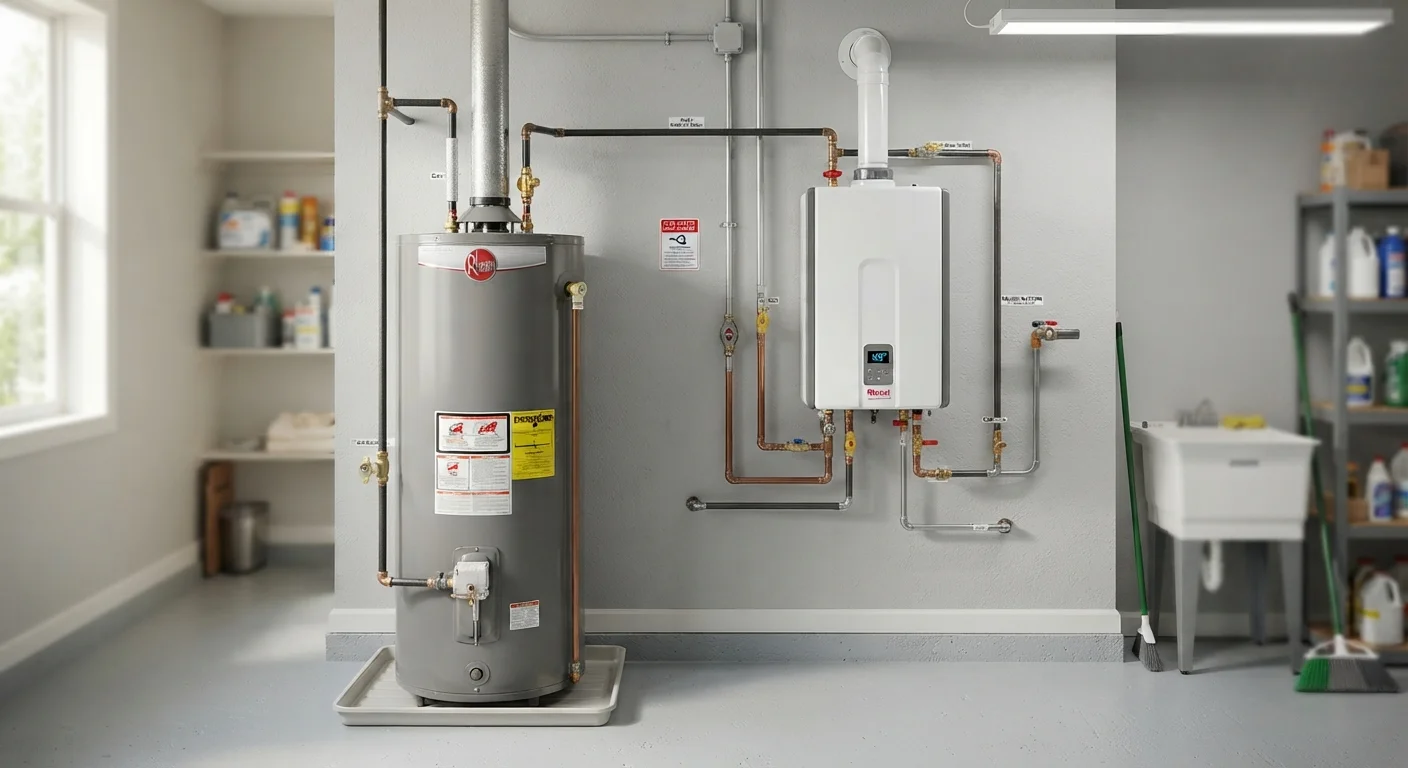
Photo: NemoFinds.com | Search, Explore, Read. editorial
Key Takeaways
- Tankless heaters cost more upfront but typically last 5–10 years longer than tank models.
- Tank water heaters are simpler to install and often cheaper to repair when something goes wrong.
- Energy savings from tankless units are real but may take years to offset the higher purchase price.
- Household size and hot-water demand patterns are the most important factors in choosing a type.
- Both types require periodic maintenance — neglecting either shortens its useful life significantly.
How Each Type Actually Works
A tank water heater stores a set volume of water — commonly 40 to 80 gallons — and keeps it heated continuously, so hot water is ready on demand. The trade-off is standby heat loss: the unit burns energy maintaining temperature even when no one's using it.
A tankless (on-demand) water heater heats water directly as it flows through the unit, using either gas burners or electric heating elements. There's no storage tank, which eliminates standby loss — but the unit must heat water fast enough to meet your real-time flow rate.
Understanding this distinction matters because it shapes nearly every other difference between them: energy use, installation requirements, performance limits, and cost. See also our overview of hidden appliance ownership costs for context on what these systems cost beyond the sticker price.
Upfront Cost and Installation Realities
Tank heaters are generally less expensive to purchase and install. A standard gas or electric tank unit typically runs $400–$900 for the unit itself, with installation adding $150–$400 depending on your home's existing infrastructure.
Tankless units carry a steeper entry point — often $800–$1,500 or more for the unit, plus installation that can reach $500–$1,500. Gas tankless models frequently require upgraded gas lines; electric models may need a panel upgrade to handle the load. These aren't optional extras — they're structural requirements that catch many buyers off guard.
Don't Underestimate Installation Costs
It's worth budgeting conservatively for installation. Getting multiple quotes from licensed plumbers or HVAC professionals before committing is a sound step.
Energy Efficiency and Operating Costs
Tankless heaters are genuinely more energy-efficient. According to the U.S. Department of Energy, on-demand heaters can be 24–34% more efficient than storage tank models for homes that use a moderate amount of hot water daily. For households using more water, efficiency gains narrow somewhat.
That said, efficiency translates to savings only over time. Depending on your utility rates and usage, the monthly savings may be modest — meaning the payback period on the higher upfront cost can range from several years to over a decade.
24–34%
Energy efficiency gain for moderate use homes
U.S. Department of Energy estimates for on-demand heaters vs. storage tank models in homes using moderate daily hot water.
15–20 years
Typical tankless heater lifespan
Industry general estimates; actual lifespan varies based on water quality, usage, and maintenance regularity.
The practical takeaway: if you're planning to stay in your home for many years and your utility costs are high, the efficiency advantage compounds meaningfully. If you're likely to move within five years, the math is harder to justify.
Lifespan, Maintenance, and Repairs
Lifespan is where tankless units have a clear edge. Tank heaters typically last 8–12 years; tankless models commonly reach 15–20 years with proper maintenance. For more on typical appliance service lives, see our appliance lifespan reference.
Both types require maintenance. Tank heaters benefit from annual flushing to clear sediment buildup. Tankless units need periodic descaling — especially in hard-water areas — and filter cleaning. Neglecting either accelerates wear. Learn more about how maintenance schedules affect home systems.
When repairs are needed, tank heaters are simpler and cheaper to fix — parts are widely available and most plumbers are comfortable with them. Tankless repairs can be more complex and costly, and some components may require a specialist.
| Tank Water Heater | Tankless Water Heater | |
|---|---|---|
| Typical upfront cost (unit + install) | $550–$1,300 | $1,300–$3,000+ |
| Average lifespan | 8–12 years | 15–20 years |
| Energy efficiency | Lower (standby heat loss) | Higher (on-demand heating) |
| Hot water supply | Limited by tank size | Unlimited, limited by flow rate |
| Installation complexity | Straightforward in most homes | May need gas/electrical upgrades |
| Repair cost and availability | Lower, widely serviceable | Higher, may need specialist |
| Space requirement | Requires floor space | Wall-mounted, compact |
Matching the Right System to Your Household
Hot-water demand patterns matter more than household size alone. A family of four that staggers showers may do fine with a properly sized tankless unit. A household that runs the dishwasher, shower, and laundry simultaneously may find a tankless unit struggling to keep up — a limitation called flow rate capacity, measured in gallons per minute (GPM).
Tank heaters buffer against demand spikes naturally. Their stored volume handles simultaneous draws, but once depleted, recovery time — how long it takes to reheat a full tank — becomes a frustration.
Size Your Unit Before You Commit
Space is another practical consideration. Tankless units are compact and wall-mounted, freeing up floor space. Tank heaters require dedicated floor area and are typically installed in basements, garages, or utility closets. If space is tight, that alone can be a deciding factor.
The content on this site is for informational purposes only and is not a substitute for professional advice. Always consult a qualified professional for guidance specific to your situation.