
What Homeowners Insurance Doesn't Cover — and Why It Matters

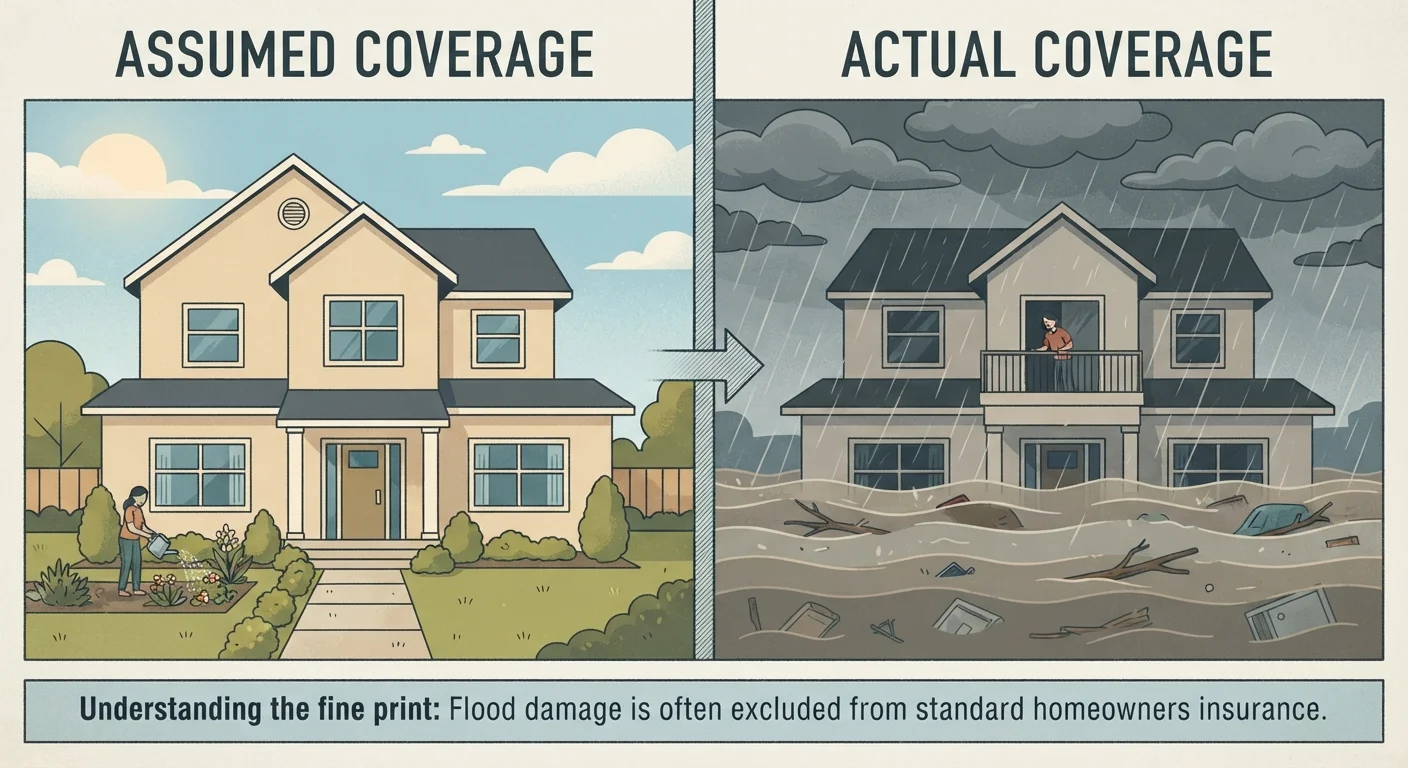
Photo: NemoFinds.com | Search, Explore, Read. editorial
Key Takeaways
- Standard homeowners policies do not cover flood or earthquake damage by default.
- Mold, sewer backups, and maintenance-related damage are commonly excluded from coverage.
- Separate endorsements or standalone policies are required to fill most major gaps.
- Always read your actual policy documents rather than assuming what is covered.
- A licensed insurance agent can help you identify which exclusions apply to your situation.
Why the Gaps in Your Policy Are More Important Than What's In It
Most homeowners assume their insurance policy works like a safety net that catches everything. It doesn't. A standard homeowners policy — typically structured as an HO-3 in the U.S. — covers your dwelling against a defined set of risks, but it deliberately excludes several of the most costly and common disasters people face. Understanding those exclusions isn't pessimistic; it's how you avoid a catastrophic financial surprise after a loss.
Before assuming you're protected, it helps to know what a standard policy actually promises — and where it stops. For a deeper look at how open-perils and named-perils structures differ, see our guide to standard vs. named-perils policies.
Myth
My homeowners insurance covers flood damage — water is water.
Fact
Standard homeowners policies explicitly exclude flooding. Flood coverage requires a separate policy, typically through the NFIP or a private flood insurer.
This is the single most dangerous misconception in homeowners insurance. The word "water damage" in a standard policy refers to sudden, internal events — like a burst pipe — not rising water from outside. FEMA estimates that just one inch of floodwater can cause more than $25,000 in damage to a home, yet millions of homeowners in moderate- and high-risk zones remain uninsured against it. If you want flood protection, you must purchase it separately.
Myth
If an earthquake damages my home, my homeowners insurance will pay for repairs.
Fact
Earthquake damage is a standard exclusion. A separate earthquake policy or endorsement is required.
Earthquake coverage must be added on — either as a rider to your existing policy or as a standalone product. This is particularly important in states along fault lines, but earthquakes have caused significant damage in regions people don't typically consider seismically active. Premiums vary significantly based on your home's location, age, and construction type.
Myth
Mold damage is covered because it usually follows water damage, which is covered.
Fact
Mold is frequently excluded, even when it results from a covered water event, unless it's explicitly included in your policy.
Some policies offer limited mold remediation coverage, but many exclude it entirely or cap it at a low dollar amount. Insurers generally treat mold as a maintenance issue, arguing that it can be prevented with prompt action after a water event. If water damage is covered but mold remediation is not, you may face a significant portion of the cleanup cost on your own. Check your declarations page and policy language carefully.
Myth
My valuable jewelry, art, and electronics are fully covered under my standard policy.
Fact
Standard policies cap coverage for high-value personal property categories. Items like jewelry, fine art, and collectibles typically have sub-limits well below their actual value.
A standard HO-3 policy might cover jewelry losses only up to $1,500 regardless of how much your pieces are worth. Cameras, musical instruments, and other specialty items often face similar caps. Homeowners with valuable property typically need a "scheduled personal property" endorsement, which insures specific items for their appraised value. This usually requires a recent appraisal and results in a modest premium increase.
Myth
If a contractor or delivery person is injured on my property, my homeowners insurance won't help.
Fact
Most standard homeowners policies include personal liability coverage that can apply when someone is injured on your property.
Liability coverage is often one of the least-discussed components of a homeowners policy — but one of the most valuable. It can help pay for medical costs and legal fees if someone is injured on your property and you're found liable. However, limits vary, and high-net-worth homeowners often add an umbrella policy for additional protection beyond the standard limits. The key caveat: coverage still depends on the specific circumstances and your policy's terms.
The Exclusions That Cost Homeowners the Most
Beyond the myths, a few specific exclusions are responsible for the majority of unexpected out-of-pocket losses homeowners face after a claim.
~40%
Homeowners in high-risk flood zones without flood insurance
FEMA data consistently shows a large share of properties in Special Flood Hazard Areas carry no flood insurance despite the documented risk.
$25,000+
Estimated damage from just one inch of floodwater
FEMA publishes this figure to illustrate how quickly uninsured flood losses can become financially devastating for homeowners.
$1,500
Typical jewelry sub-limit on standard HO-3 policies
Most standard homeowners policies cap jewelry coverage at this amount, far below the value many policyholders assume is protected.
Flood damage is the most consequential exclusion. The National Flood Insurance Program (NFIP), administered by FEMA, exists precisely because private insurers largely won't cover it. If your home sits in a flood-prone area — or even a moderate-risk zone — a separate flood policy is worth evaluating. Similarly, earthquake coverage requires a separate endorsement or standalone policy in most states.
Sewer and drain backups are another frequent blindspot. Standard policies typically exclude damage caused by water backing up through a sewer or drain, even if the backup results from a storm. Many insurers offer a sewer backup endorsement for a modest additional premium.
Gradual damage and neglect are excluded almost universally. If your roof leaks because it hasn't been maintained, or if wood rot develops over years of moisture exposure, your insurer is unlikely to pay. Policies are designed to cover sudden, accidental losses — not the results of deferred upkeep.
Don't Wait for a Claim to Read Your Policy
If a claim has already been denied and you're trying to understand why, our article on why home insurance claims get denied walks through the most common reasons and your options afterward.
This article is for general informational purposes only and is not a substitute for personalized insurance, legal, or financial advice. Coverage terms, exclusions, and availability vary by insurer and by state. Read your actual policy documents carefully and consult a licensed insurance agent or adviser for guidance specific to your situation.
The content on this site is for informational purposes only and is not a substitute for professional advice. Always consult a qualified professional for guidance specific to your situation.