
Compound Interest: The Concept Every New Investor Should Understand First

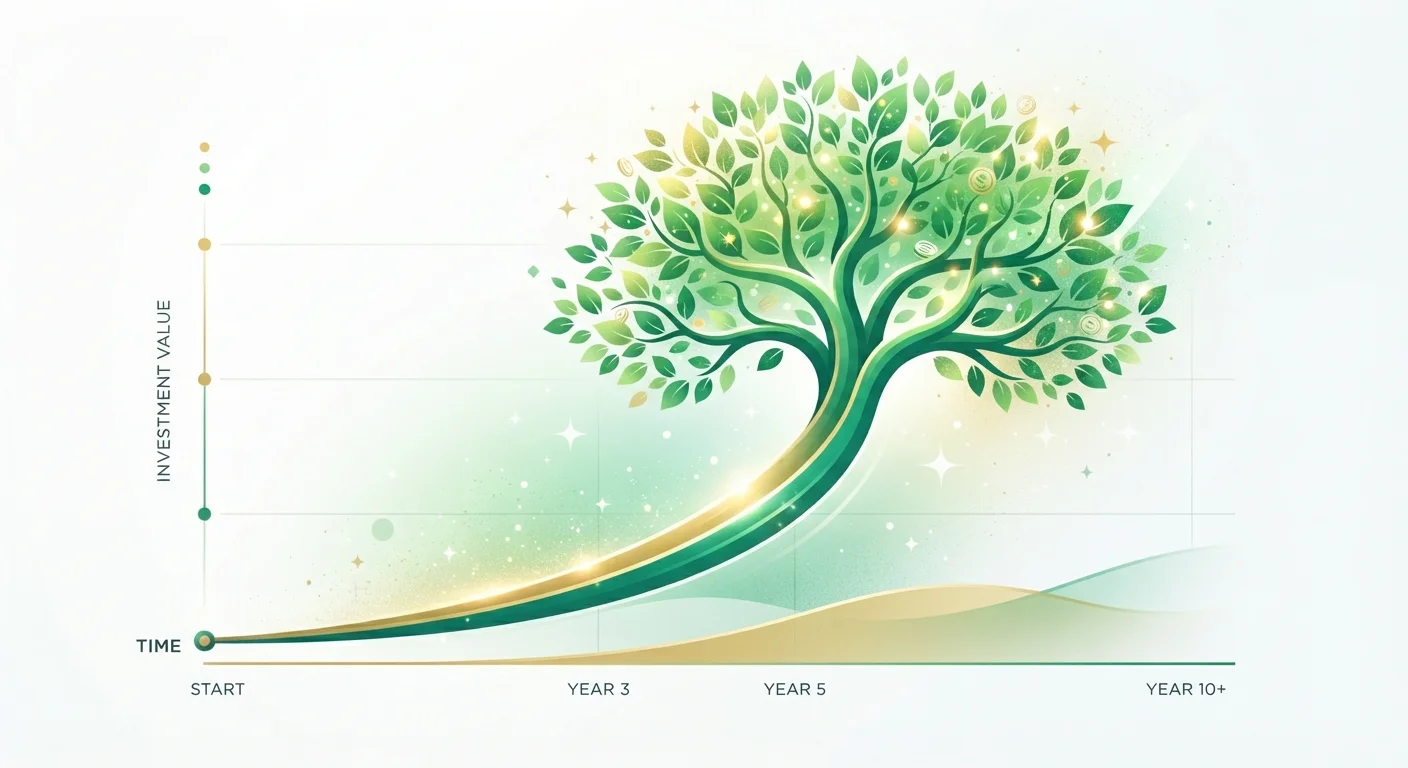
Photo: NemoFinds.com | Search, Explore, Read. editorial
Key Takeaways
- Compound interest earns returns on both your original money and previously earned gains.
- Starting earlier matters more than the size of your initial contribution.
- Compounding works against you just as powerfully when applied to debt.
- Consistent, long-term investing tends to benefit most from compounding effects.
- Time in the market, not timing the market, is what compounding rewards most.
Why Compound Interest Is the First Concept to Understand
Before diving into stocks, funds, or retirement accounts, there's one foundational idea that shapes nearly every long-term financial outcome: compound interest. If you understand nothing else about investing, understanding this changes how you think about both saving and spending.
Most people learn that investing can grow their money, but the mechanism behind that growth rarely gets explained clearly. Compound interest is that mechanism. It's why two people investing identical amounts can end up with dramatically different results based purely on when they started — and it's why financial professionals consistently emphasize time horizon above almost everything else.
To understand investing at all, start here. For a broader foundation, learn what investing actually means before diving deeper.
~$38,000
Value of $5,000 after 30 years at 7%
Illustrative projection using standard compound interest formula at 7% annual growth, compounded annually — no additional contributions.
10+ years
Advantage of starting investing in your 20s vs. 30s
Financial educators broadly cite time horizon as the single most influential variable in long-term compound growth outcomes.
22%+
Typical APR on credit card debt in the U.S.
Federal Reserve data has consistently shown average credit card interest rates above 20%, highlighting compounding's cost when applied to debt.
How the Math Actually Works
Consider a straightforward example. Suppose you invest $5,000 and it earns a 7% annual return. In year one, you earn $350 — bringing your balance to $5,350. In year two, you earn 7% on $5,350, not the original $5,000. That's $374.50, bringing you to $5,724.50. Each year, the base grows, and so does the return.
Over 10 years at 7%, that $5,000 grows to roughly $9,836 — nearly doubling without a single additional contribution. Over 30 years, the same $5,000 becomes approximately $38,061. The growth isn't linear; it curves upward. That curve is compounding at work.
The key variables are the interest rate, how often it compounds, and — above everything else — time. Longer time horizons give compounding the runway it needs to produce results that seem almost counterintuitive at first glance.
“Compound interest is the eighth wonder of the world. He who understands it, earns it; he who doesn't, pays it.”
— Widely attributed to Albert Einstein, Quote of uncertain origin, widely circulated in financial education contexts
Why Starting Early Matters More Than Starting Big
The most striking implication of compounding is that early contributions are worth disproportionately more than later ones. An investor who begins at 25 and contributes consistently for 10 years — then stops — can end up with more at retirement than someone who starts at 35 and contributes for 30 uninterrupted years. The numbers depend on the return rate, but the general pattern holds across virtually every reasonable scenario.
This doesn't mean later starters are out of options. It means the cost of delay is real and measurable. Every year you wait isn't just a year of missed contributions — it's a year of compounding that can never be recovered. That's a concrete, mathematical reality, not a motivational cliché.
Automate to Remove the Temptation to Wait
If you're ready to put compounding to work, the logical next step is understanding what to know before opening your first investment account.
The Other Side: Compounding and Debt
Compound interest is symmetrical. The same math that grows investments also grows unpaid debt — and often faster, because consumer debt typically carries higher rates than investment returns. A credit card balance left unpaid compounds monthly, meaning interest accrues on interest. Over time, a manageable balance can expand significantly.
Understanding this dynamic helps explain why paying down high-interest debt before investing heavily is a strategy many financial educators recommend. The "guaranteed return" of eliminating a 20% interest rate often outweighs uncertain investment gains. This is general educational context — your specific situation warrants guidance from a licensed financial professional.
For a complete picture of how compounding interacts with different asset types, see our overview of stocks, bonds, and funds. And if you're wondering whether common fears about investing are actually warranted, these investing myths may be worth examining.
This article is for general informational and educational purposes only. It does not constitute personalized financial, investment, tax, or legal advice. Consult a qualified financial professional before making decisions about your own financial situation.
Frequently Asked Questions
The content on this site is for informational purposes only and is not a substitute for professional advice. Always consult a qualified professional for guidance specific to your situation.