
Index Funds and Actively Managed Funds: A Side-by-Side Look

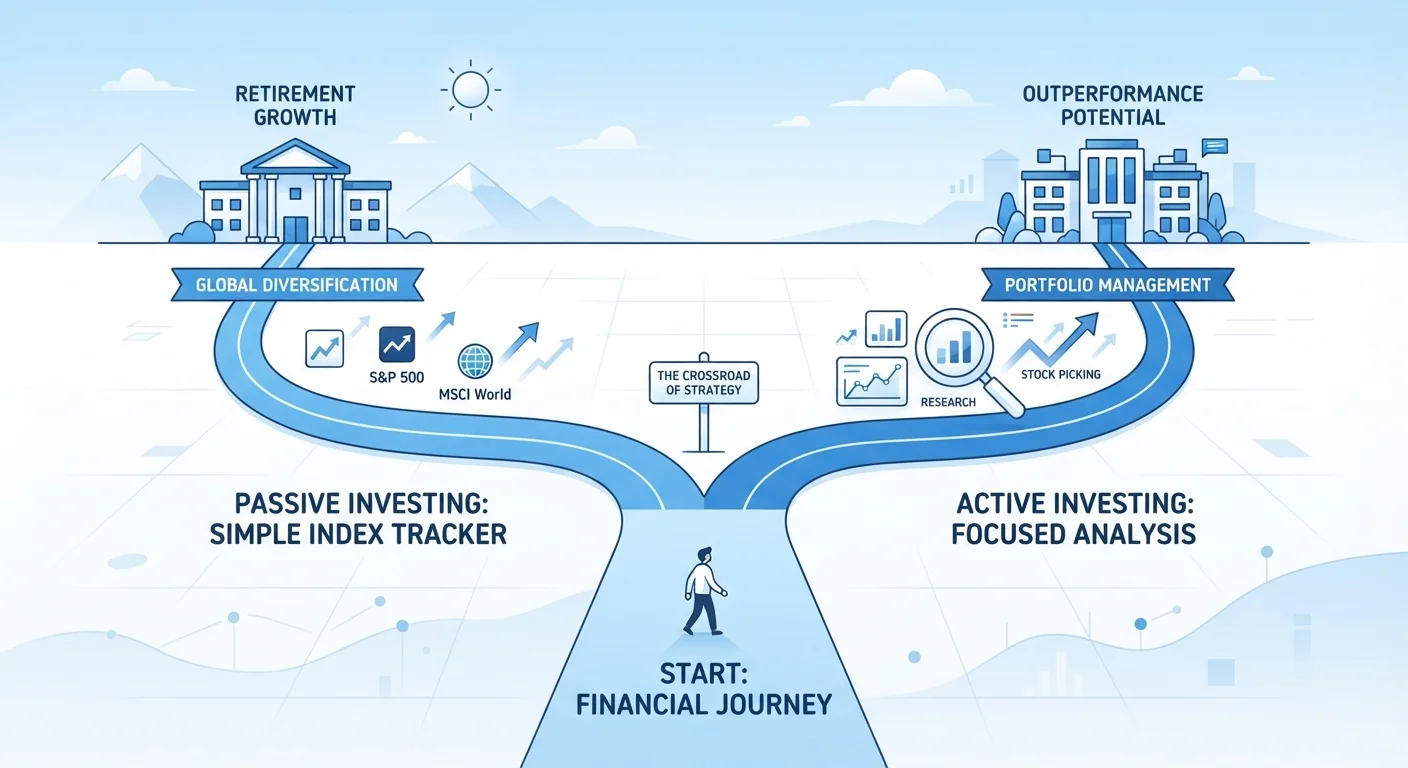
Photo: NemoFinds.com | Search, Explore, Read. editorial
Key Takeaways
- Index funds passively track a market benchmark and typically carry lower fees than actively managed funds.
- Actively managed funds employ professional managers who aim to beat the market, but most fail to do so consistently over the long term.
- Cost differences between the two approaches compound significantly over decades of investing.
- Neither approach is universally superior — your time horizon, risk tolerance, and goals all matter.
- Both fund types can coexist in a single portfolio depending on your overall strategy.
How Each Fund Type Works
Before comparing them, it helps to understand what each fund actually does. If you're new to the topic, our guide to stocks, bonds, and funds covers the foundational concepts.
Index funds are passively managed. Instead of a team of analysts picking individual securities, an index fund simply mirrors a market benchmark — such as the S&P 500 or a total bond market index. When the benchmark rises or falls, the fund follows. The fund manager's job is to replicate the index as accurately as possible, not to outperform it.
Actively managed funds work differently. A portfolio manager — supported by a research team — makes deliberate decisions about which securities to buy, hold, or sell. The stated goal is to outperform a benchmark index by capitalizing on market inefficiencies, economic forecasts, or company-specific analysis.
Both structures pool money from many investors and offer built-in diversification, but the investment philosophy and day-to-day operations are fundamentally different.
Costs: Where the Numbers Diverge
The expense ratio — the annual fee charged as a percentage of assets — is where the two approaches differ most visibly. Because index funds require minimal trading and no active research team, their costs tend to be substantially lower.
~0.05%
Typical index fund expense ratio
Many broad market index funds carry expense ratios well below 0.10%, reflecting minimal trading and no active research costs.
~0.66%
Average active equity fund expense ratio
The Investment Company Institute has reported average active equity fund expense ratios significantly above those of passively managed counterparts.
Over 80%
Active funds underperforming their benchmark over 15 years
S&P Dow Jones Indices' SPIVA reports have consistently shown that most active U.S. equity funds lag their benchmarks over long periods after fees.
These differences may look small in isolation. On a $10,000 investment, a 0.05% expense ratio costs $5 per year; a 1.0% ratio costs $100. Over 30 years, assuming the same gross return, that gap compounds into thousands of dollars. Cost-awareness is one of the habits that seasoned investors consistently emphasize.
Actively managed funds may also generate more taxable events due to frequent trading, which can further reduce after-tax returns in taxable accounts. Index funds, with their lower turnover, tend to be more tax-efficient in this respect.
| Index Funds | Actively Managed Funds | |
|---|---|---|
| Management style | Passive — tracks a benchmark | Active — manager selects securities |
| Typical expense ratio | Very low (often under 0.10%) | Higher (often 0.5%–1.5% or more) |
| Goal | Match market returns | Beat market returns |
| Trading frequency | Low — mirrors index changes | High — ongoing buy/sell decisions |
| Tax efficiency | Generally higher | Generally lower |
| Long-term track record vs. benchmark | Competitive by design | Most underperform over 10+ years |
| Transparency | Holdings mirror known index | Holdings vary by manager strategy |
Performance: What the Evidence Shows
The core promise of active management is market-beating returns. Research from organizations like S&P Dow Jones Indices has consistently found that the majority of actively managed equity funds underperform their benchmark index over periods of 10 years or more, after fees. This doesn't mean no active fund ever outperforms — some do — but identifying those funds in advance is genuinely difficult, even for professionals.
Past outperformance by an active fund is not a reliable predictor of future results. Manager tenure changes, market conditions shift, and the very strategies that worked in one environment may not translate to another.
Look Beyond Gross Returns
Index funds, by design, will never beat the market — but they also won't significantly lag it. For investors focused on consistent, long-run participation in market growth, that predictability has real value. For more on common investor missteps that erode returns, see why new investors often derail their own returns.
Choosing an Approach That Fits Your Situation
Neither fund type is inherently right for every investor. Several practical factors are worth weighing:
- Time horizon: The longer the horizon, the more fee differences compound. Index funds tend to show stronger relative advantages over very long periods.
- Tax situation: In tax-advantaged accounts like IRAs or 401(k)s, the tax-efficiency advantage of index funds is less pronounced. If you're comparing account types, understanding how IRAs are taxed is a useful parallel consideration.
- Goals and complexity: Some investors use actively managed funds for specific exposures — international markets, alternative strategies, or income-focused mandates — where they believe specialized management adds value.
- Behavioral fit: If you're prone to second-guessing your portfolio, a straightforward index strategy may help you stay the course. Many investing myths are rooted in the belief that constant active management is necessary for success.
A blended approach — using index funds as a core holding and selectively adding active strategies — is also common. Whatever you choose, consulting a licensed financial adviser for guidance tailored to your specific circumstances is strongly recommended.
This article is for general informational and educational purposes only and does not constitute personalized financial or investment advice. Past performance of any investment type does not guarantee future results. Consult a qualified financial professional before making investment decisions.
The content on this site is for informational purposes only and is not a substitute for professional advice. Always consult a qualified professional for guidance specific to your situation.