
The Debt Snowball and Debt Avalanche: What Sets Them Apart

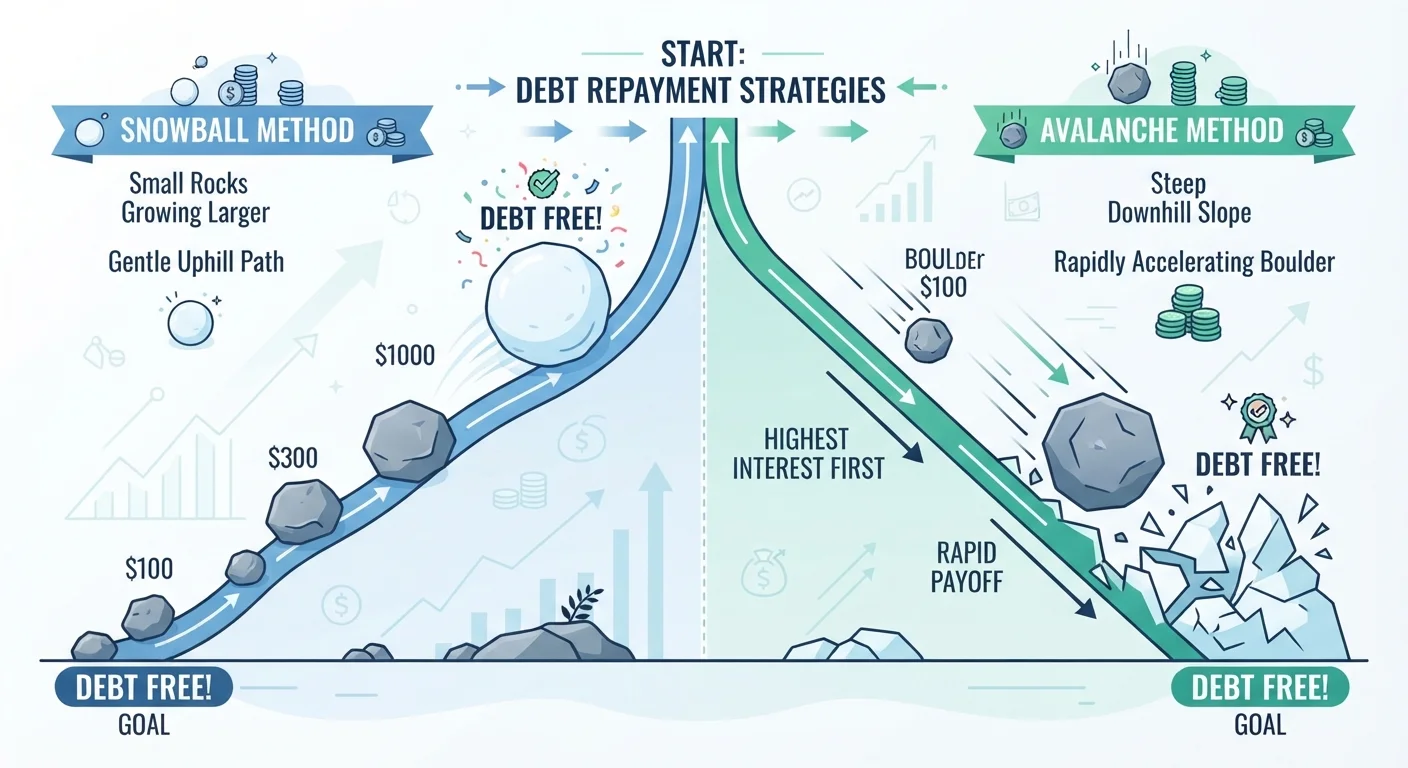
Photo: NemoFinds.com | Search, Explore, Read. editorial
Key Takeaways
- The debt snowball targets the smallest balance first; the debt avalanche targets the highest interest rate first.
- The avalanche method typically saves more money in interest over time, assuming consistent execution.
- The snowball method produces faster early wins, which research suggests can improve follow-through.
- Both methods require paying minimums on all debts and directing extra funds to one priority account.
- The best method is the one a person can actually stick with — consistency outweighs theoretical savings.
How Each Method Works
Both strategies share the same foundation: pay the minimum on every debt each month, then direct any extra money toward one specific target. The key difference is how that target is chosen.
Debt Snowball: List your debts from the smallest balance to the largest, ignoring interest rates. Pay extra toward the smallest balance until it's gone, then roll that freed-up payment into the next-smallest debt. The payoff amounts compound like a snowball rolling downhill.
Debt Avalanche: List your debts from the highest annual percentage rate (APR) to the lowest. Direct extra funds to the highest-rate debt first. Once it's eliminated, redirect that payment to the next-highest rate, and so on.
Neither method requires you to earn more money or dramatically cut spending — they're frameworks for allocating whatever surplus you already have. For a structured way to identify that surplus and set up your plan, see our step-by-step debt payoff guide.
| Criterion | Debt Snowball | Debt Avalanche |
|---|---|---|
| Payoff order | Smallest balance first | Highest interest rate first |
| Primary benefit | Motivational momentum | Lower total interest paid |
| Interest cost | Typically higher overall | Typically lower overall |
| Early wins | Frequent — accounts close fast | Slower — progress less visible |
| Complexity | Simple to implement | Requires tracking APRs |
| Best suited for | Motivation-driven individuals | Analytically focused individuals |
| Risk of abandonment | Lower (due to quick wins) | Higher if progress feels slow |
The Math: Where the Methods Diverge
Consider a simplified example: three debts — $500 at 8% APR, $3,000 at 22% APR, and $7,000 at 14% APR — with $200 in extra monthly funds available.
Under the snowball, you'd target the $500 balance first, paying it off quickly, then move to the $7,000 debt, then the $3,000 debt. The early victory is real, but the 22% balance keeps accruing interest throughout.
Under the avalanche, you'd attack the $3,000 at 22% first, even though it isn't the smallest. Over time, neutralizing that high-rate account reduces the total interest the debt pile generates each month.
Mathematically, the avalanche will almost always result in less total interest paid and a shorter payoff timeline — in some scenarios, meaningfully so. However, the real-world gap depends heavily on the specific balances and rates involved. In situations where rates are clustered closely together, the financial difference may be smaller than expected.
~$1,000s
Potential interest saved via avalanche
Financial planners generally note that on a typical household debt load, the avalanche can save hundreds to thousands in interest versus the snowball, though exact amounts vary by balance and rate profile.
80%
Americans carrying some form of debt
According to Pew Research Center data, roughly eight in ten Americans carry some form of debt, underlining the broad relevance of structured payoff strategies.
Psychology, Consistency, and Real-World Outcomes
Personal finance researchers have explored why people abandon debt payoff plans, and early discouragement is a consistent factor. The snowball method's design addresses this directly by engineering small, frequent victories that reinforce the behavior of paying extra toward debt.
A well-cited 2012 study published in the Journal of Marketing Research found that focusing on eliminating individual accounts — rather than reducing aggregate balances — improved debt payoff rates in practice. This is the behavioral argument behind the snowball.
That said, discipline and clarity of purpose can make the avalanche equally effective for many people. If you clearly understand why you're targeting a high-rate balance — even when it feels slow — the mathematics can itself become motivating.
The honest reality: a consistently executed snowball outperforms an abandoned avalanche every time. Choosing the method you'll actually follow is more important than choosing the theoretically superior one. You may also want to consider whether debt consolidation could simplify your repayment structure before committing to either approach. And if broader money behaviors are slowing your progress, our piece on habits that quietly slow debt payoff is worth a read.
Hybrid Approaches Are Valid
Fitting Your Strategy Into the Bigger Picture
Whichever method you choose, it doesn't exist in isolation. Debt payoff competes with other financial priorities — building an emergency fund, contributing to retirement accounts, and managing monthly cash flow. These trade-offs don't have a single right answer.
Our guide to whether extra money goes further toward debt or savings can help you think through that balance. For a broader framework covering both sides simultaneously, see managing savings and debt at the same time.
The structural habits that support long-term debt freedom — consistent budgeting, avoiding new high-rate debt, building a small emergency buffer — matter as much as which payoff order you choose. For more on those principles, see our article on principles that support long-term debt freedom.
This article is for general informational and educational purposes only and does not constitute personalized financial or legal advice. Consult a qualified financial professional regarding your specific situation.
The content on this site is for informational purposes only and is not a substitute for professional advice. Always consult a qualified professional for guidance specific to your situation.