
Roundabouts, Four-Way Stops, and Yield Signs: Who Actually Goes First

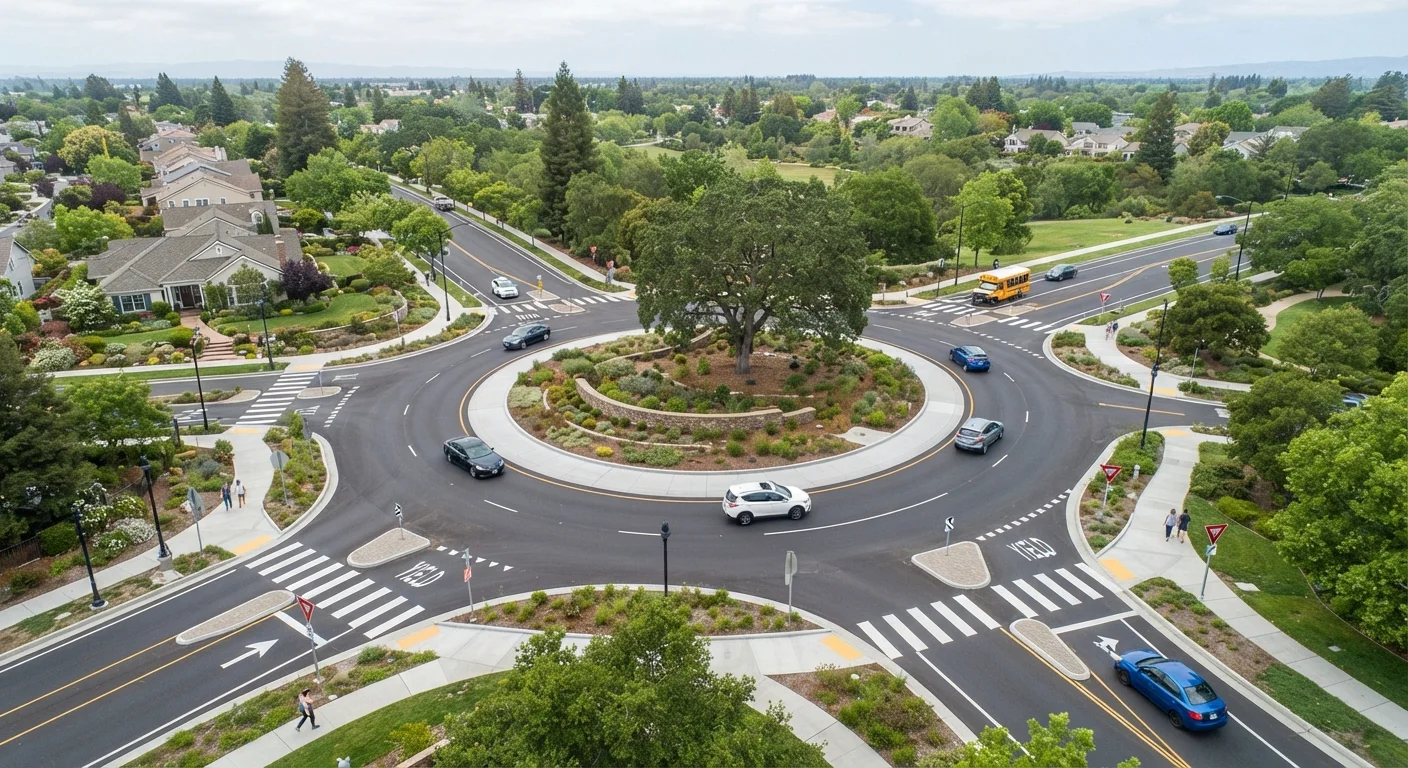
Photo: NemoFinds.com | Search, Explore, Read. editorial
The Core Principle Behind Every Right-of-Way Rule
Right-of-way rules exist to create a predictable order at places where vehicle paths cross. When drivers understand and respect that order, traffic flows and collisions drop. When they don't, intersections become the site of roughly 40% of all U.S. traffic crashes, according to NHTSA.
The core idea is simple: one vehicle must go first, and traffic law assigns that role based on position, arrival time, and traffic control devices. No driver is ever entitled to force their way through. Even holding the legal right-of-way, you are expected to yield if doing so prevents a crash.
40%
Of all U.S. traffic crashes occur at intersections
According to the National Highway Traffic Safety Administration's intersection safety data.
75%
Reduction in serious injury crashes at roundabouts
Compared to traditional stop- or signal-controlled intersections, per Federal Highway Administration research.
21%
Of fatal crashes involve failure to yield
Failure to yield is consistently one of the top contributing factors in fatal collisions, per NHTSA data.
For a broader look at safe habits on the road, see the First-Timer's Safe Driving Roadmap — a solid foundation before drilling into specific rules.
Right-of-way
The legal right to proceed through an intersection or road section before another driver. Right-of-way is assigned by traffic laws, signs, and signals — it is never demanded or assumed.
Yield
To slow down or stop as needed to allow other vehicles or pedestrians with the right-of-way to pass before you enter or cross a roadway.
Roundabout
A circular intersection where traffic flows counterclockwise around a central island. Entering vehicles yield to those already circulating inside.
Four-way stop
An intersection where all approaches have stop signs. Drivers take turns based on arrival order and, when simultaneous, by position relative to one another.
Uncontrolled intersection
An intersection with no signs or signals. Drivers apply the right-of-way rule of yielding to vehicles already in or approaching from the right.
Merge
The act of smoothly joining a lane of moving traffic, typically on highways or after lane reductions. The merging driver generally yields to traffic already in the target lane.
Four-Way Stops: Arrival Order and the Tie-Breaker Rules
A four-way stop is one of the most misunderstood scenarios on American roads. Here is how it actually works:
- First to arrive, first to go. The vehicle that reaches the stop line first has the right-of-way. Full stop, signal, then proceed.
- Simultaneous arrival — yield to the right. If two vehicles arrive at the same time, the driver on the left yields to the driver on the right.
- Opposite directions, going straight — both may proceed. Two cars facing each other and both going straight can move at the same time.
- Turning left yields to oncoming straight traffic. If you are turning left and an oncoming driver is going straight or turning right, they go first.
- Three or four cars at once — use arrival order and right-of-way rules in sequence. Take it one vehicle at a time; make eye contact and use turn signals to communicate intent.
Confusion usually happens when drivers wave others through out of politeness, disrupting the established order. Predictability is safer than courtesy at a four-way stop.
Roundabouts: Yield Before You Enter, Then Flow
Roundabouts are designed to keep traffic moving while dramatically reducing the angle and speed of potential collisions. The single rule is: yield to all vehicles already circulating inside the roundabout before entering.
| Most common right-of-way scenario | Four-way stop intersections (NHTSA intersection safety guidance) |
| Roundabout injury reduction vs. traditional intersections | Up to 75% fewer serious injury crashes (Federal Highway Administration roundabout research) |
| Default yield rule at uncontrolled intersections | Yield to the vehicle on your right (Uniform Vehicle Code, adopted across U.S. states) |
| Pedestrian right-of-way at crosswalks | Pedestrians always have priority in marked or unmarked crosswalks (Most U.S. state traffic codes) |
| Roundabout circulating speed | Typically 15–25 mph (FHWA Roundabout Guide) |
Practical steps for navigating a roundabout:
- Slow down as you approach — typical entry speeds are 15–25 mph.
- Yield at the dashed line. Wait for a safe gap in circulating traffic.
- Enter counterclockwise and stay in your lane.
- Signal your exit and exit smoothly without stopping inside the roundabout.
Multi-lane roundabouts follow the same principle. Choose your lane before entering based on your intended exit — left lane for turns further around, right lane for early exits — and avoid changing lanes inside the circle.
The city driving habits guide covers additional scenarios like lane merging and urban intersection navigation.
Yield Signs, Merges, and Uncontrolled Intersections
Yield signs require you to slow — and stop if necessary — and allow crossing or merging traffic to pass before you proceed. Unlike a stop sign, a yield sign does not require a complete stop if the way is clearly open.
Highway on-ramps and lane merges operate on a similar principle. The merging driver is responsible for matching the speed of highway traffic and finding a gap. Traffic already in the lane generally has the right-of-way, though courteous drivers often adjust to allow a merge. Do not stop at the end of an on-ramp unless absolutely necessary — match speed first.
Uncontrolled intersections (no signs or signals) require drivers to yield to any vehicle already in the intersection, then yield to the vehicle on the right if arriving simultaneously. Treat these with extra caution; both drivers may be uncertain.
Right-of-Way Cannot Be Demanded
Pedestrians and cyclists add another layer: in most U.S. states, pedestrians in crosswalks — marked or unmarked — have the right-of-way. Always scan crosswalks before proceeding, even when you have a green light.
New and returning drivers will also find common new-driver risk patterns worth reviewing, as right-of-way errors rank among the most frequent early mistakes.
This article provides general driver education information based on widely applicable U.S. traffic principles. Traffic laws vary by state and locality — always consult your state's official DMV handbook and obey posted signs and signals in your jurisdiction.
The content on this site is for informational purposes only and is not a substitute for professional advice. Always consult a qualified professional for guidance specific to your situation.