
Air Drying vs. Blow Drying: What Each Method Does to Your Hair Over Time

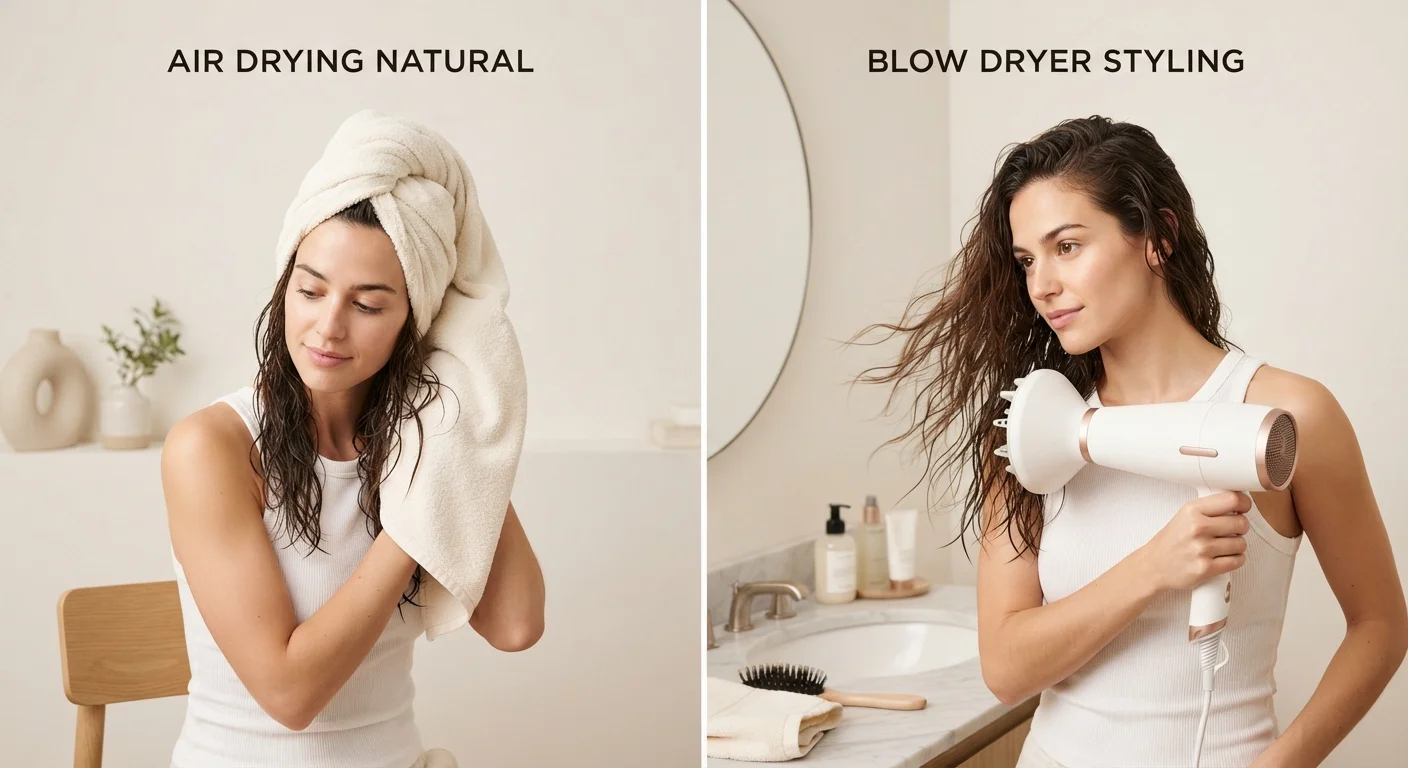
Photo: NemoFinds.com | Search, Explore, Read. editorial
Key Takeaways
- Air drying avoids heat damage but prolonged wetness can temporarily weaken hair strands.
- Blow drying speeds up drying time but high heat causes protein degradation and cuticle damage over time.
- Using a diffuser on low heat is a middle-ground option that reduces both risks.
- Curl pattern and hair porosity significantly influence which method works best for your hair.
- Hair prep — including conditioner use and gentle towel drying — matters as much as the drying method itself.
What Actually Happens to Hair When It's Wet
Wet hair is hair in its most vulnerable state. When water enters the hair shaft, it causes the inner structure — called the cortex — to swell. The outer layer, the cuticle, lifts slightly to accommodate this. In that swollen, lifted state, hair is more elastic but also more prone to mechanical damage from combing, rubbing, or tension.
Research published in the Journal of Cosmetic Science has found that keeping hair wet for prolonged periods can temporarily weaken the hydrogen bonds that give hair its shape and strength. This means the longer hair stays saturated, the longer it remains in this fragile phase — a relevant consideration for those with very thick or dense hair that takes hours to dry naturally.
Understanding this baseline helps explain why both drying methods involve real trade-offs rather than one being universally superior. For a deeper look at how moisture interacts with your specific hair type, see our guide on curl patterns, shrinkage, and moisture retention.
How Each Method Affects Hair Over Time
The key differences between air drying and blow drying show up not just in a single session but in cumulative long-term effects on strand integrity.
| Criterion | Air Drying | Blow Drying |
|---|---|---|
| Heat exposure | None | Moderate to high |
| Dry time | 30 min – several hours | 5–20 minutes |
| Cuticle impact | Swelling from prolonged wetness | Lifting and roughening from heat |
| Curl definition | Generally preserves curl | Can disrupt curl without diffuser |
| Risk of mechanical damage | Higher (fragile when wet longer) | Lower if done correctly |
| Best for scalp health | Neutral (avoid sleeping wet) | Reduces prolonged scalp moisture |
| Porosity sensitivity | High-porosity hair may frizz | Works across porosity types |
Air drying eliminates direct heat, which sounds straightforwardly better — and for avoiding thermal damage, it is. However, the extended wet phase means hair spends more time in a structurally weak state where even gentle friction from a pillow or movement can cause mechanical breakage. Swelling and repeated drying cycles also stress the cuticle over time.
Blow drying, when done at high heat without protection, raises the surface temperature of the hair shaft significantly, causing moisture inside the strand to expand rapidly and create tiny bubbles in the cortex — a phenomenon researchers call bubble hair. This leads to brittleness, split ends, and dullness. The damage compounds with each high-heat session. That said, heat styling done carefully — using lower temperatures, a heat protectant, and constant movement — meaningfully reduces these risks.
~450°F
Surface temp some blow dryers reach on high
Studies in hair science have measured scalp-adjacent temperatures on high-heat dryer settings that far exceed the threshold for protein denaturation in hair.
30%+
Increase in hair elasticity loss when wet
Research on hair mechanics indicates that wet hair can lose more than 30% of its tensile strength compared to dry hair, underscoring the fragility of the wet phase.
Curl Pattern, Porosity, and Why Your Hair Type Changes the Equation
No single drying recommendation fits every hair type. Two factors matter enormously: curl pattern and porosity.
Curl pattern affects how air flows around the strand. Tightly coiled hair has more surface area and more twists for air to navigate, which significantly extends natural dry time. For this reason, people with 4A–4C curl types often find that air drying leads to hours of vulnerability — and potentially more scalp issues — while a diffuser on low heat can be a practical solution that respects curl definition without aggressive heat.
Porosity — how readily hair absorbs and releases moisture — also shapes the outcome. High-porosity hair (which often results from chemical processing or heat history) absorbs water quickly but loses it just as fast, making it prone to frizz when air drying in humid conditions. Low-porosity hair resists water absorption, meaning it can stay wet longer even under a blow dryer at moderate heat.
Pairing your drying method with solid conditioning habits also matters. Our breakdown of conditioners, deep conditioners, and hair masks explains how pre-drying moisture support can shore up strand resilience regardless of which method you use.
The Diffuser: A Useful Middle Ground
Practical Strategies for Both Methods
Getting the most out of either method comes down to a few consistent habits:
- Microfiber towel or cotton T-shirt first: Gently blot — don't rub — excess water before air or blow drying. This shortens the vulnerable wet phase without heat.
- Detangle before drying: Wet combing causes less breakage when done with a wide-tooth comb and a leave-in conditioner to provide slip.
- If blow drying, use a heat protectant: These products form a barrier that slows heat transfer to the cortex. Apply to damp, not soaking wet, hair for best coverage.
- Keep the dryer moving: Concentrating heat in one spot for too long dramatically increases surface temperature. Continuous motion is one of the simplest damage-reduction strategies.
- Low or medium heat is usually enough: Most hair types dry adequately on medium settings; the highest heat settings are rarely necessary for everyday drying.
For days when you air dry, try to avoid sleeping on wet hair — the prolonged pressure and friction from bedding on a wet scalp can contribute to both breakage and scalp irritation. If you notice scalp changes like persistent flaking, our guide on dandruff versus dry scalp can help you identify what's going on.
The content on this site is for informational purposes only and is not a substitute for professional advice. Always consult a qualified professional for guidance specific to your situation.