
Following Distance Explained: The Gap That Could Save Your Life

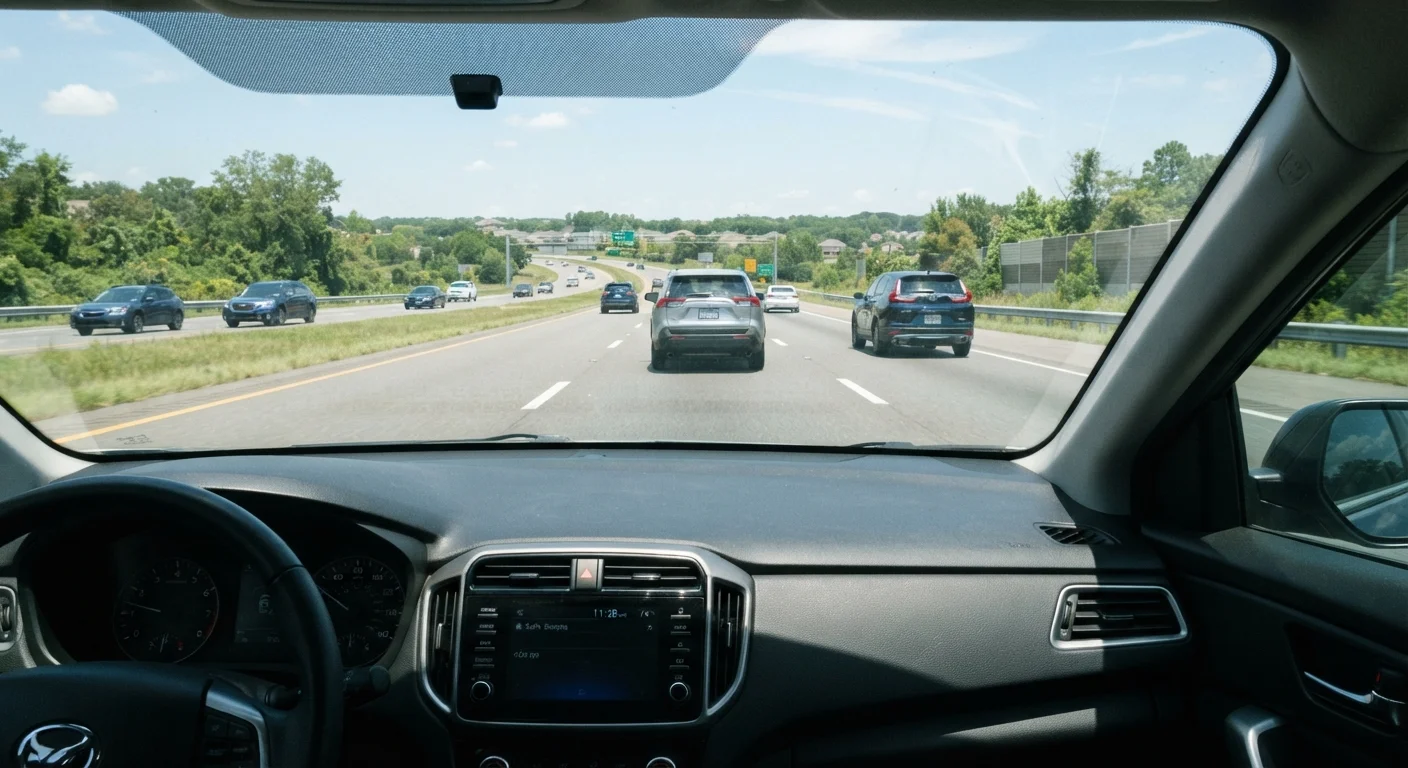
Photo: NemoFinds.com | Search, Explore, Read. editorial
Key Takeaways
- The three-second rule is the standard baseline for safe following distance under normal conditions.
- Rear-end collisions are among the most common crash types, and tailgating is a leading contributing factor.
- Following distance must increase in rain, fog, heavy traffic, nighttime conditions, or when towing.
- Reaction time alone — before braking even begins — typically consumes about 1.5 seconds of gap.
- Experienced drivers are just as likely as new drivers to gradually let following distance shrink over time.
Why the Gap in Front of You Matters
Most drivers think of crashes as something that happens when conditions are extreme — ice, fog, or a reckless driver running a red light. In reality, one of the most frequent crash scenarios is entirely preventable: a driver simply follows too closely and cannot stop in time when traffic slows ahead.
According to the National Highway Traffic Safety Administration (NHTSA), rear-end collisions account for roughly one-third of all crashes in the United States annually. Inadequate following distance is a primary contributing factor. The gap you maintain is not just empty road — it is your reaction time made visible.
Understanding following distance is a cornerstone of defensive driving, the practice of anticipating hazards before they become emergencies.
~33%
Share of U.S. crashes that are rear-end collisions
According to NHTSA data, rear-end collisions consistently represent approximately one-third of all reported crashes in the United States.
1.5 sec
Average driver reaction time before braking
Traffic safety research commonly cites 1.5 seconds as a typical perception-reaction time, meaning a vehicle travels significant distance before braking even begins.
~264 ft
Distance covered in 3 seconds at 60 mph
At 60 mph, three seconds of travel equals roughly 264 feet — illustrating why car-length estimates are less reliable than time-based rules.
The Three-Second Rule: How to Use It
The three-second rule gives drivers a practical, real-time method for checking their following distance at any speed:
- Pick a fixed object ahead — a road sign, overpass, or painted line on the road.
- Watch the vehicle in front pass it, then start counting: one-thousand-one, one-thousand-two, one-thousand-three.
- If you reach that same object before finishing the count, you are too close. Ease off the accelerator to open the gap.
Three seconds is the baseline under ideal conditions — dry pavement, good visibility, normal traffic. It is not the upper limit. Many driving safety programs recommend extending to four or five seconds as a habit, because it costs very little and adds meaningful protection.
Adjust Your Count for Larger Vehicles
Keep in mind that reaction time alone — the delay between seeing a brake light and your foot actually pressing the pedal — averages around 1.5 seconds for most drivers. At 60 mph, you travel roughly 132 feet before you even begin to brake. That reality underscores why three seconds is the floor, not a generous allowance.
When Three Seconds Isn't Enough
Following distance is not a fixed number — it is a variable buffer that should expand when conditions make stopping harder or visibility worse.
- Rain and wet pavement: Wet roads roughly double your stopping distance. A four-to-five-second gap is a reasonable adjustment.
- Ice and snow: Braking distances can increase dramatically. Add several additional seconds and reduce speed accordingly.
- Night driving: Reduced visibility affects how quickly you can identify a hazard ahead. Nighttime driving introduces risks that extend well beyond just following distance.
- Towing a trailer: Added weight and length increase stopping distance significantly. Allow more gap than you think you need.
- Heavy traffic: Frequent stop-and-go patterns mean hazards appear with less warning. Resist the pressure to close the gap just to prevent other cars from merging in front of you.
New drivers in particular often struggle to calibrate appropriate gaps in changing conditions. First-year driver risk patterns frequently include late braking and inadequate spacing as contributing factors.
How Tailgating Habits Form — and Fade
Tailgating is rarely a deliberate choice. More often it develops gradually through familiarity and time pressure. Experienced drivers — who should know better — are just as prone to letting their following distance compress as new drivers are. Complacency after years of incident-free driving is a well-documented pattern.
Common reasons drivers close the gap include:
- Running late and subconsciously trying to "push" traffic along
- Feeling that leaving space invites other vehicles to merge
- Driving on autopilot without actively monitoring gap size
- Overconfidence in braking ability or reflexes
Refreshing safe-distance habits is part of broader defensive practice. Safe driving habits that fade with experience are often the most dangerous, precisely because they are invisible to the driver who has lost them.
The straightforward fix is conscious recalibration: use the three-second rule actively during each drive, not just when conditions feel risky.
Frequently Asked Questions
The content on this site is for informational purposes only and is not a substitute for professional advice. Always consult a qualified professional for guidance specific to your situation.